Early morning in Brussels, Louise and I were sipping coffee and looking at a map while our friend Ilona got her kids off to summer classes. The girls were searching around for their riding gear and Jack was banging a spoon on the table. It was a whirlwind of activity just as we were waking up.
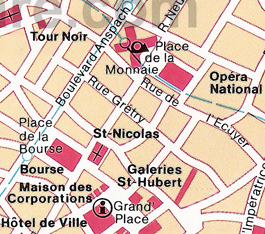
Ilona handed Louise a bus ticket and pointed to the map. We would take a bus on la rue du Trône into the city and get off at the stock exchange, called La Bourse. We could then wander around and later meet Ilona at her office in the afternoon. I knew that I wanted to go to the Magritte museum and Louise knew she wanted a Belgian waffle smothered in chocolate. Beyond that, our aim was to explore.

I was in love with the map. Palais des Congrès, Gare Centrale, and Notre Dame aux Riches Claires. Place names, streets, and cultural markers, all in French.
With a shout, I jabbed my finger at a spot on the map that read la rue de L’Ecuyer, a small street about three blocks long near the Place de la Monnaie and the Opéra National. I was elated to have such a personal place to start. “Well,” Louise planted her hand on the table, “I guess we’ll be going there.” The next street we found was Avenue Louise, and we were out the door.
I’ve had the name L’Ecuyer for more than forty years, and a day rarely goes by when I don’t spell it, pronounce it, or smile politely when someone speaks to me en français. If I’m feeling courageous and they seem patient, I might try to carry on a conversation. It was easy to do that in Brussels. It’s the capital city of the European Union and they speak three languages—Flemish, French and English—sometimes all at once.
Our family doesn’t come from this region, but that didn’t keep me from trying to find my place in the French culture around us. We stepped out of Ilona’s beaux arts row house onto the narrow cobblestone street. I read the signs out loud, practicing against Louise’s pronunciation, as we passed le pâtisserie and la laverie. There was a salon called Chez Julie and a boulangerie named Paul. By the end of the day, I noticed myself thinking in French and trying to form sentences to describe the quaint streets, palatial architecture, and sense of history around us.
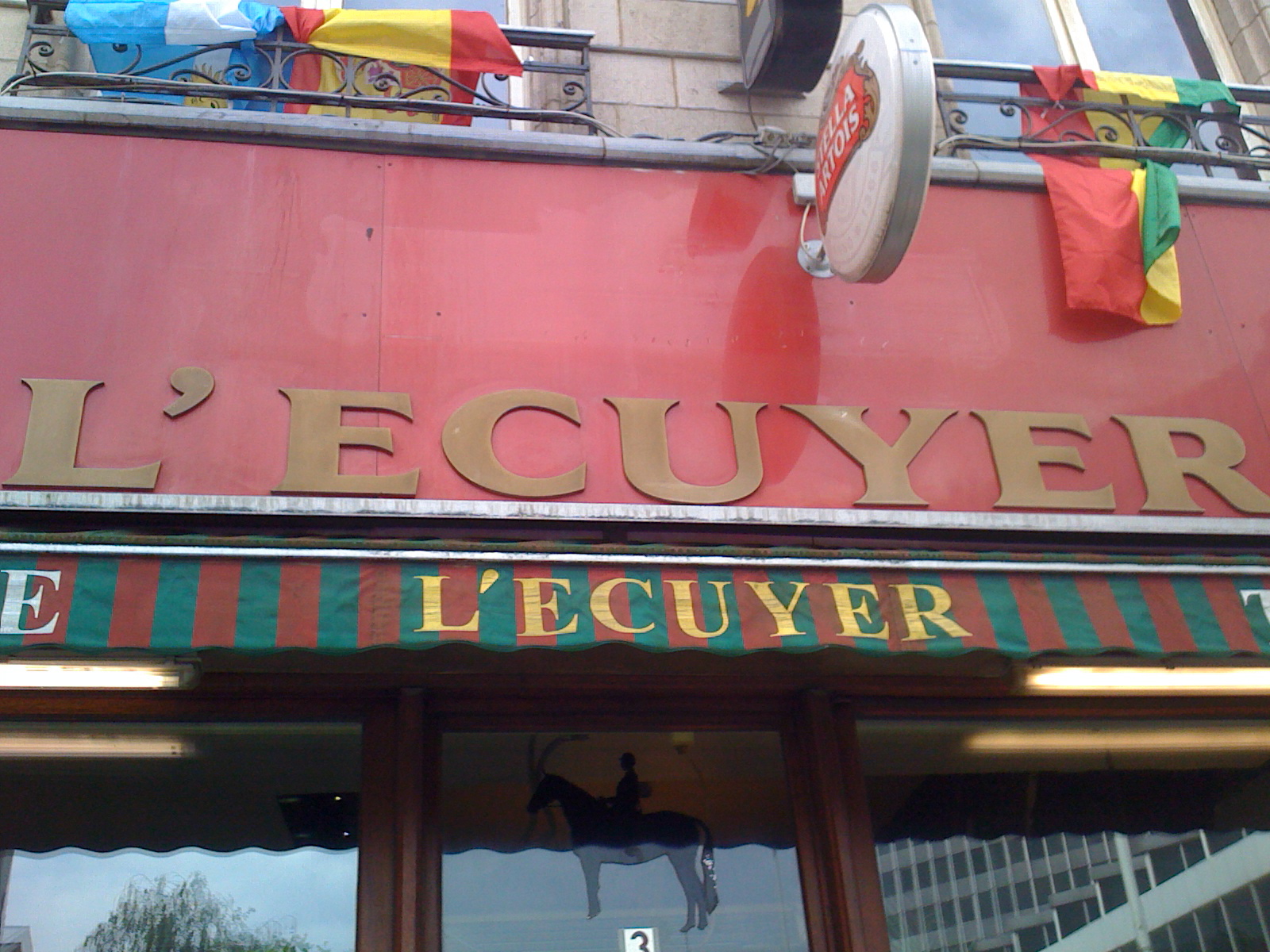
After a bus ride that wound through the center of the medieval city, we walked a few blocks and turned the corner onto my street. It was impossible to miss the first sign, an awning with our surname emblazoned across the front. We took selfies outside and summoned up the courage to go inside the pub to speak to the staff. Neither of us really wanted a beer, but I did want something with my name on it to take home.

The broken French I used to explain my request to the barkeep was appalling. To begin, I should have said, Je m’appelle Anne. What I did say, Mon nom est Anne, is less like an introduction and more like a statement of fact. Then I asked if she had some ice cream (la glace) or a map (la carte). What I wanted was a glass (une verre) or a menu (un menu) that I could purchase or take away. Others began to stare and finally Louise helped make sense of what I meant. They laughed along with us, but alas, nothing to take home.

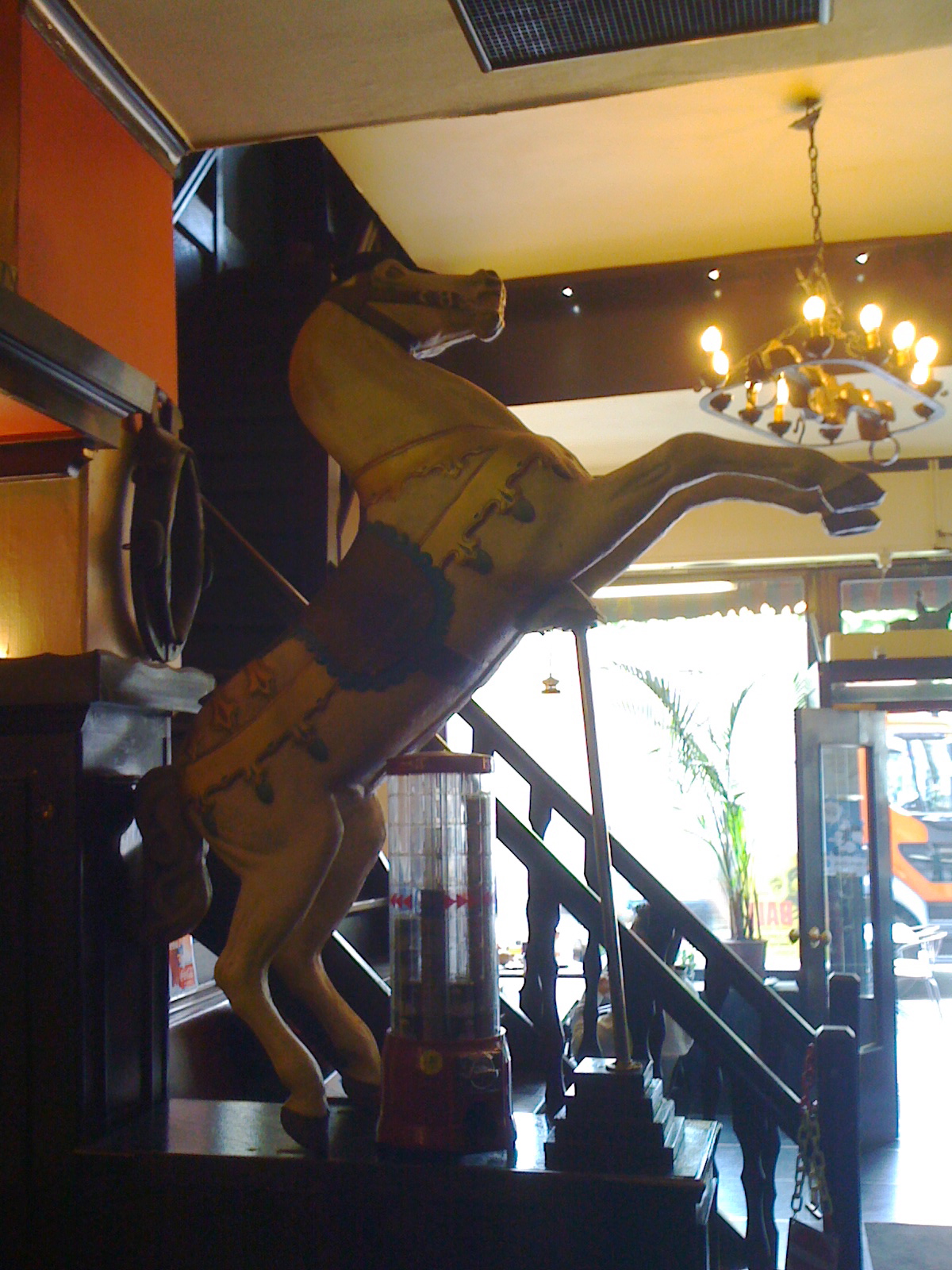
I did get a dim-lit picture of the carousel horse in the center of the pub, which seems prophetic now. I was only beginning to understand how our name related to le cheval and le chevalier, the horse and the knight. That story would take new turns throughout the summer as I learned more about l’ecuyer and l’ecuyère in history and art.
In the French middle ages, the title l’ecuyer was given to young men whose job it was to assist a knight, and who might become knights themselves someday. To me the title implies trust and youthful promise. The job was to look after the knight’s horse, weapons and armor, to stand in for him at times, and to rescue him from battle if necessary. Our name later came to mean ‘esquire’ or what the British call an ‘equerry’ which is a man of some status who serves as an aid or representative to a person of great rank. Many people now think of ‘esquire’ as a synonym for ‘lawyer.’
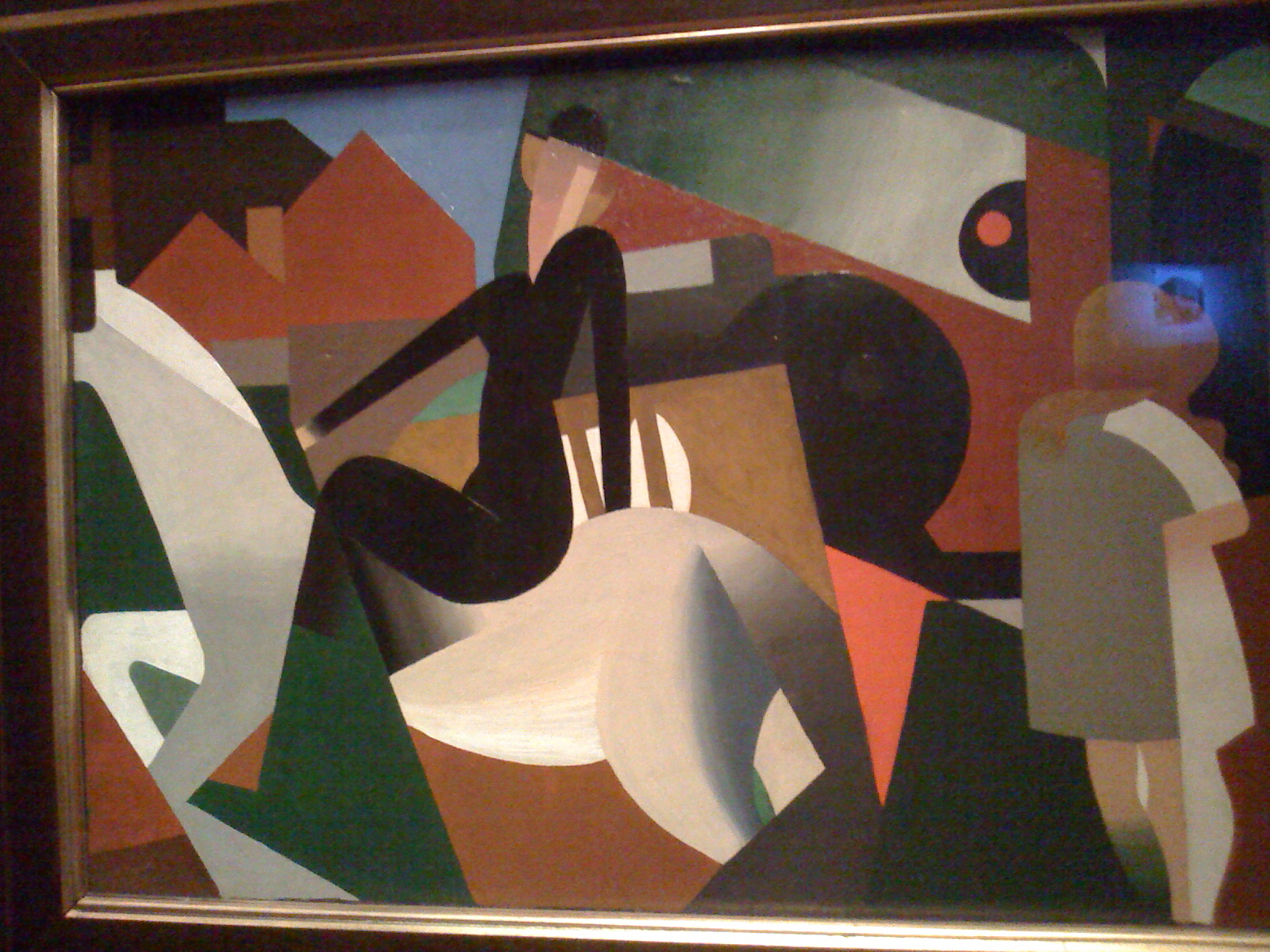
After Louise and I left the pub, we found ourselves three levels up in a dark gallery of the Musée Magritte. “Over here,” she said. I turned to my left and made my way over to her. She pointed to the label next to a large painting by the famous surrealist. I had to get very close to it to see that it was titled L’ecuyère.

I looked to either side and thought for a moment about the museum’s rule against taking pictures. I decided that this clue about my history was more valuable than their propriety in this instance so I held my iphone discreetly in front of me. Remarkably, there was no attendant in the room at the moment. I snapped a single shot of the painting and another of the label that bears its title, then I shoved my phone in my pocket and quickly moved to another gallery.
There is no female equivalent of l’ecuyer in the Middle Ages, but after 1926 the female figure of l’ecuyère appears in popular French culture and the artwork of other masters of the era like Picasso, Matisse, Seurat, and Chagall. At times she is depicted as a noble woman riding a white horse. She also appears as a flamboyant acrobat who performs tricks with show horses in the circus. Seeing the female figure in the painting shifted my perspective slightly. Now I seemed to be seeking my own history (not my father’s) and everywhere I looked horses, French culture, and our name began to appear.
We had just come from a visit with Louise’s dad and his wife Eunice in Spain where they live near a small village north of Málaga. Their house is perched on the side of a mountain and they have a stable with three horses there. Shortly after we arrived it was time to bring them in from the paddocks.
Eunice was in her dirtiest shorts and work boots. She handed a lead rope to Louise, another one to me, and said, “Anne, you go with Graham.” She meant for me help Graham lead the third horse back up the hill. I was afraid at first, but I remembered that horses can easily sense fear. I focused and calmed my breath as we walked out to where they stood in the afternoon sunlight.
Graham and I had Enrique, the most dominant horse, and somehow we ended up at the back of the line. As we walked, Enrique pushed toward his rightful spot and nearly shoved me off the side of the hill. Eunice looked back and understood our dilemma. Enrique was not about to stay in third place. She called me forward to take the lead for her horse, and moved Enrique up to the front where he belonged.

Once the horses were in, Eun began mixing their food in huge rubber buckets. I tried to memorize the recipe as I watched. Then we hauled the buckets out to them, filled up their water, gave each some hay, and mucked out their stalls with a shovel and a wheelbarrow. I was eager to learn and followed her around like an apprentice for the next few days. I wondered was I subconsciously inhabiting some innate role? Was I yearning to be a second set of hands?
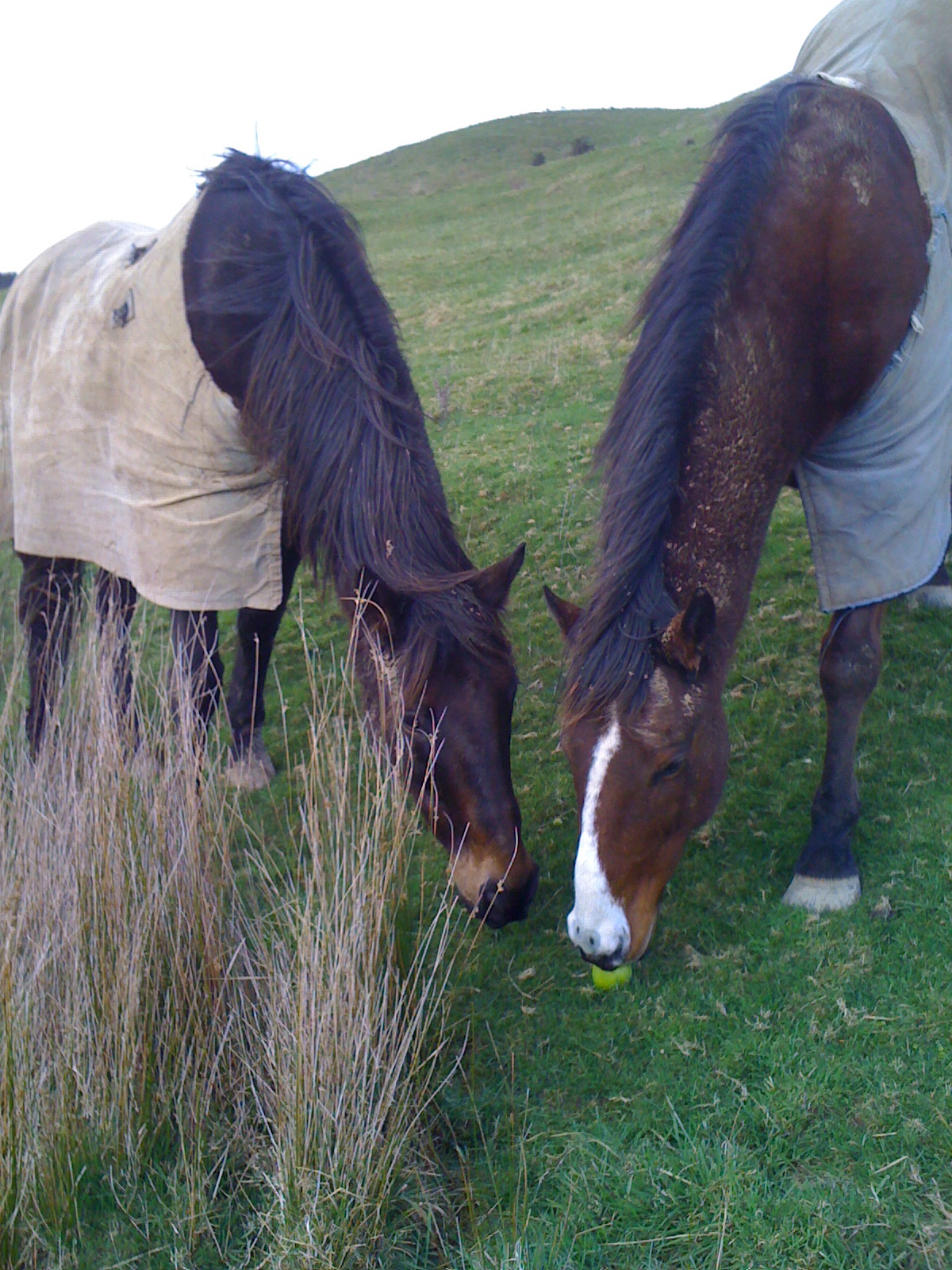
Later at New Pacific Studio in New Zealand, I would befriend two horses at the next farm over who greeted me each time I went out for a hike. I’d caught onto the horse theme by then so I was curious to spend time with them. I took apples with me once and got a few beautiful pictures out in a pasture. They were calm and shy, but they followed me as far as the next fence. I imagined what it would be like if my job was to care for these creatures. How would a humble l’ecuyer live today?
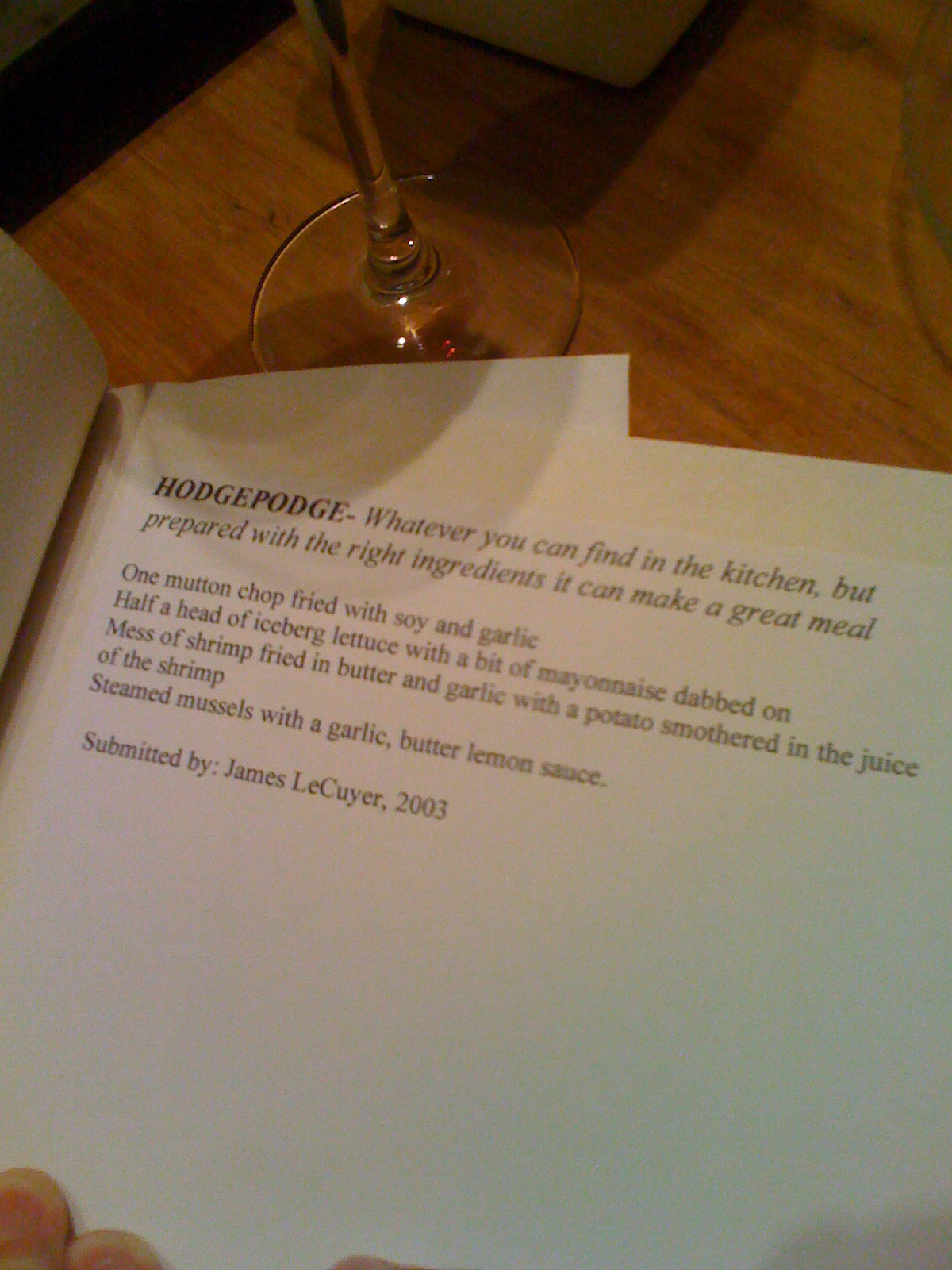
One night back at the retreat, my friend Kathy and I were making dinner and looking through a homemade cookbook in which other writers had left their favorite recipes. Kathy just finished telling me how she loved the challenge of making a fabulous dinner from whatever was left in the fridge. Right then, I turned the page in the cookbook to one that said, “Hodge-podge, whatever you can find in the kitchen but prepared with the right ingredients can make a great meal.” The page described shrimp in butter sauce over a potato and a few other impromptu combinations. I gasped when I saw that the entry was signed James LeCuyer, 2003.

“Do you think you’re related?” asked Kathy.
My answer was a long one and Kathy let me ramble for a while. I recounted the stories we had gathered over the past few months along with family memories and my own feelings about our heritage. It wasn’t the first time I’d run into someone who shared the same last name but it felt more personal just then. I studied the recipe card, as if I could divine some connection between us from the clues in front of me. He was a writer and could make a good meal from not much at all. How many times has he spelled his name? Does he know he comes from a long line of able and loyal attendants?
Discover more from Anne L'Ecuyer
Subscribe to get the latest posts sent to your email.


This is awesome, Anne! How fun that you experienced so many coincidences on your trip and that you were able to able to come back with such a great set of stories.
LikeLike