Lock Arms, Ladies

[draft in progress]

Women are the dominant force in the micro industry cluster labeled by the Bureau of Labor Statistics as cultural events managers. The category includes staff positions from companies like Disney and places like Las Vegas, those professionals who run large public and private events on a routine basis. It includes positions like the White House Social Secretary who command sizable budgets and media attention and whose productions have national meaning, as well as contractors who produce neighborhood events like classes and workshops. This relatively small network of professionals is largely women, which makes it an interesting one to study from the lens of leadership.

Theories of leadership have been in development since ancient philosophy and are present in all world civilizations. A lineage of leadership theory (largely Western in origin) has been mapped out in progressive stages, with us approaching an important point of integration. We know enough about leadership now to understand that it comes in multiple forms, is place and time dependent, and requires a diversity of perspective to operate at a social level.

It is typical and routine for a creative profession to be at the forefront of change in leadership style. By definition, creative work requires the practitioner to take hold of the future. She produces events and experiences that happen there (event planning is a thing) and designs the style and message of the event, which have inherently cultural implications always.

The practice of integrative leadership is more common among cultural events managers than it is in other labor groups. There are structural reasons for that, including the functional necessity of teams in event production, multiplicities of resource allocations, and the evolution of technologies that allow for more complex productions. The specific correlations for class and gender matter too. A dominant combination of women and working class people on a team is more likely to produce an integrative leadership style. Teams are central to event production, and integrative leadership is central to team-based productivity.

It wasn’t always so and even recent organizational leadership theory attempts to retain a formal, charismatic leader as the inspiration and engine of a team. He stands at the front of a room, presumes to know a plan, directs others’ work, and is ultimately held accountable for team performance. That may still be the organizational mandate most cultural events managers toil under, but that’s not how they work.

Rooted in traditions older than leadership theory, women and working people have ways of accomplishing meaningful action together. These leadership styles (and their aims, strategies and methods) are better understood through the lens of family, friendship, and community than they are through modern organizational theory. How young leaders learn these traits and habits (at home and in civic spaces) is a topic for another post. For now, we can safely assume that they know what they’re doing.

So what can this tiny, nearly invisible class of industrial professionals tell us about leadership right now? Let’s ask them.

[draft in progress]


Creative sector helps Americans face collective fears

IMG_8703

Today’s NY Times article Fear in the Air, Americans Look Over Their Shoulders reports that Americans are “engulfed in a collective fear, a fear tinged with confusion and exasperation and a broad brew of emotions,” and that a ‘fear of the ordinary’ has a grip on our collective experience. Violence is nearby and close to home – at work, at the grocery, and in our cultural spaces. Though it may not affect us personally, it’s made personal by the news and more pressing as holiday season begins and 2015 ends.

Like faith leaders and educators, artists know how fear works on a culture and in the creative process. First, it roots in the psyche as an obsession that focuses the attention. On a mundane level, you can’t get it out of your mind. It’s present as a confounding dilemma in everyday life and sometimes becomes a framing question for a period of time.

In transformative creative practice, those mundane obsessive fears eventually develop into an excruciating 11th hour. The ideas keep us awake, vexation increases, and the weight of the rumination demands a creative solution. Artists routinely make a morning rush to the studio after staring in a dark mirror through the night. Whether it’s a frustrating technical problem or a revelation of the soul, the build up of emotion and release is common in our world, and productive.

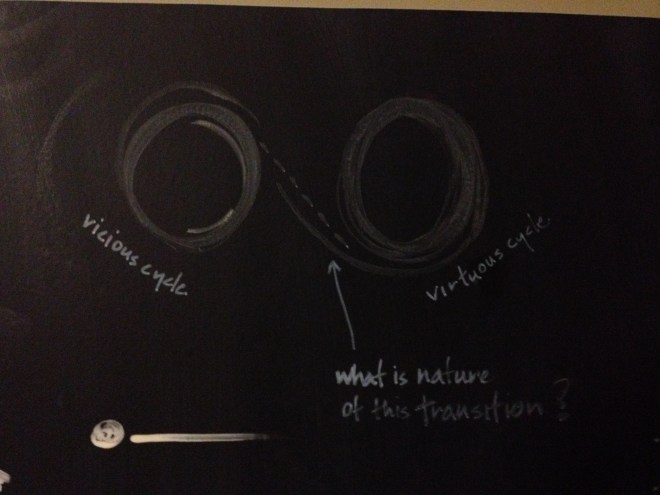
To be sure, the vicious cycle of anxiety can go the other way, and Americans’ cultural obsession with tragedy and denial of accountability could spiral into what an artist might call ‘unproductive territory.’ We do it by indulging in vices, producing unfocused work madly, playing with our toys, or chasing after shiny objects. Creative practitioners who struggle to make it through those anxieties and back to creative work often suffer through depressions and addictions. For many artists, dealing with fear is the primary purpose of their creative practice. The test of career resilience is returning to the studio each time. Mundane fears that transform into new interest, hope and career advancement are ultimately worth it – the price of creative satisfaction. Those that go unattended don’t often go unexpressed, though, and those results can be tragic.

If Americans are indeed in the grips of a vicious cycle of anxieties about violence and retribution, it’s certainly worth looking to the creative sector for help. The insights on creative practice that come from individual studio artists are immediately relevant, and the $698 billion industry (representing 4.32% of GDP in 2012) could come in handy too. Cultural spaces in the United States are deeply integrated into the fabric of our cities, are well-positioned to be the sites of creative transformation in American communities, and have been trending toward populist engagement since the 1970s. As much as we are touted for our robust international exports, most American artists are employed locally and prepared to work on behalf their communities as masters of their trades, teachers, and on strategy and design teams.

President Obama was as prophetic as he was prosaic at in his speech for the Celebration of American Creativity. “It’s our artists who hold up a mirror to our society, reminding us of our common purpose and our collective obligations,” he said. “Our music, in particular, has always been an honest reflection of who we really are. A reflection of our successes and our shortcomings, our adversity and our imagination, of our recklessness and our stubborn insistence on blending the old with the new, tradition with experimentation.” As often as we are symbolic, the creative sector is also ordinary. We have the ability to communicate instantly through powerful symbolic acts, and an even larger capacity to maintain American resilience in the face of mounting fears closer to home.

The Paris attacks brought the terrorism fight to the creative sector, which may be an ironic step forward toward resolution of mounting global crises. As expected, French artists have responded with keen cultural leadership, and other countries are following suit with government policy oriented toward collectively expressing our cultural anxieties. For example, Italy’s Renzi plans to tackle terrorism with culture by investing equal amounts in security and cultural access.

Though I’d welcome a similar federal investment in Washington, I don’t think we should wait. We find ourselves again On the Pulse of the Morning and as Maya Angelou says, “Each new hour holds new chances.” Americans struggling to cope with their mounting fears should connect with the creative sector, face the dark mirror together, and take hold of our shared capacities and collective fate.


Being present for others takes practice

Much of my job involves being present for others in a helpful way. A colleague arrives with a dilemma or an opportunity. They spell it out for me in their own terms and I repeat back what I hear. I listen for strengths first, and then places where alignment may be off. Then we chat it out toward a good next step or resolution.

Basic line drawing is akin to following the breath. I love it!

I appreciate people. Mostly I find us fascinating and I’ve experienced enough suffering to know that being there for each other is really all there is. It’s no wonder I gravitated to the arts as a profession. Subjectivity is lovely.

I strengthen my own presence through artistic practice. Paying very close attention to ideas and words. Iterating concepts in multiple forms. Bending shape back into language where it has gone stiff. I do it primarily to make sense of the world for myself, but it also prepares me to be present with others.