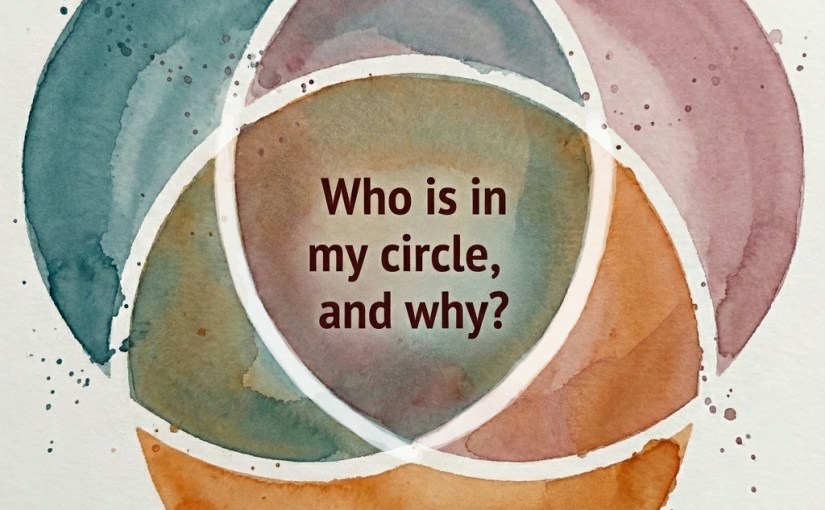
Circle Up


Question 8 on the Creating slide really got me thinking this time.

Q: Who is in your circle, and why?

It’s a practical question for me. My next studio circle (and my own creative practice) starts anew on January 7, and continues every Wednesday afternoon this year.

I’d love for you to join me next week or any Wednesday. My commitment to my creative practice is weekly, and I’m here every week to support yours.

In a quiet moment before the holidays I wrote a long list of everyone I have to thank this past year, plus all the people who left me wiser, and often awestruck.

The task in Question 8 is to acknowledge each person, and seek to know more about how they arrive or appear in my circle. It’s not an inventory, it’s a diagram. Who am I choosing to keep close and who is drifting away? And, what does my circle say about my values and how I communicate.

Caregiving changed my circle. Job transitions change it, always. Loss changes it. Some people move closer, others take off on a distant orbit. Some surprise you when they show up. The circles we create together become life boats when everything else shifts. Leaning forward changes it, too.

What happens on Wednesdays?

We gather on Zoom for 90 minutes. I introduce one or a pair of the questions—sometimes we’re completing the work behind us, sometimes creating the path ahead, sometimes both at once. We explore it together for 30 minutes.

Then you work solo for 30 minutes, mics off. Write, collage, draw, use whatever medium you choose. No need for special supplies or skills. Whatever is at hand—a notebook, some magazines and glue, colored pencils. Not your phone. We love technology, obviously, but tactile is important in this studio.

We reconvene for 30 minutes of reflection. You share only what you want—a sentence, an image, a phrase. No advice-giving, fixing, or solving. The circle makes space for you to listen to your own good sense, work your own puzzle, and most importantly, choose your own metaphor. If you want advice from anyone in the circle, simply ask privately.

How it works

Working through the questions alone has value. Working through them in a studio circle can be transformative. Weekly creative practice builds momentum, provides the pace of trust needed for relationships, and allows insight to unfold. We watch your work evolve together. Eventually, you trust the circle and it is safer to bring what’s difficult, tender, unfinished.

This year, especially, you are welcome. When we are all navigating transitions, tending to loved ones, reinventing our work, renewing our purpose, and searching for meaningful connection. A circle you can count on once a week may be essential. It is for me.

Join me on Wednesdays

We meet every Wednesday from 2:00-3:30 PM Arizona time via Zoom. Join for $5/month or $50/year for unlimited Wednesdays.

January 7 is special because we start the new cycle together. But every Wednesday works. Pretend we’re neighbors and drop-in. I do not mind.

Who is in my circle?

People who show up consistently. People who witness without judgment. People doing their own creative work and willing to support others in theirs. People who understand that making art—in whatever form—is how we make sense of our lives.

I hope you’ll be one of them, some Wednesday in the year ahead.


Time Traveling

As writers we know the practice takes time. Ten weeks, ten months, ten years. Today happens to be all three for me.

Ten years ago I closed the Washington Writer’s Retreat. After a wonderful five-year run hosting 31 artists, scientists, historians, anthropologists, poets, novelists, and grandmas, the retreat closed in 2014. I traded the marginal magic of the house on Bunker Hill for the rich intimacy of life next to Louise in a quiet condo. I knew my proof of concept would keep, and the need to become my next me was calling.

Ten months ago, we did the Completing and Creating Circle, a pretty great exchange all around. I came away with a drive to go deep into research on a couple of writing projects. Ironically, the time together informed an incubation period that had to be solo, and I committed to a full writing practice. I embody the moniker ‘erstwhile essayist’ here on annelecuyer.com, a space that often functions as R&D for other projects.

Ten weeks ago (or so) I started writing one essay each Wednesday for The Posted Past. This new enterprise draws on Dad’s very old postcard collection. It fills our time together, tipping the mind marbles every day to start a fun game of sorting, selecting, and detecting. Fortunately, artistic practice thrives in these crumpled corners of life. Centenarian postcards make for writing magic.

I see all this as evidence of the ripple effect in my own life, a lovely looping quality that allows for time travel.

Back to WWI and the Golden Age of Postcards, and an extraordinary time of personal engagement town-to-town and around the globe.

Forward to a time when I finish a novel thirty years in the making using AI to crush the blocks I faced in my early writing days. Forthcoming, Night Reading.

Back again through our family history to develop the draft of Crazy Creative, a social memoir on powerful women in the margins. Still so muted at this moment, it only leaks out when I’m not looking.

Slowly, my confidence grows that these efforts are all toward many more comfortable places for humans to love and writers to work. Always, I practice on myself.

Air We Share

I opened LinkedIn to scroll a bit while waiting for Dad to return from the senior center. Excited to see that a close colleague had written an important piece, I clicked in to read. I expected fierce commitment to cause and profound challenge to dominant power. I did not expect to find my own words briefly quoted out of context, turned back in a sideways slant.

We had been in professional conversation for several years, but something was rudely amiss, so I immediately paused our weekly meetings. We were in a relationship tangle that needed release, not pull. I felt mansplained, masked, and a mean stroke coming toward me from a person I admire. Time and self-inquiry would help me know better how to respond.

I read the essay a few times more, especially focused on what made sense to me and aligned with our conversations. Nearly all of it, but a few undignifying tropes were tucked in a throw-away paragraph. ‘Naive’ appeared thoughtlessly as a critique of change-oriented strategies. A scarcity mindset that doubles down on scarcity is a mental racket. Also obvious, framing an ‘other’ as a fool or foil.

It seemed my colleague hadn’t taken in much of what I had said. Years of deliberation and a whole social philosophy fit blithely into a few dismissive sentences. I understood it as an editorial error, too – a paragraph to either expand or drop.

I know this critique pretty well. Each time I dutifully ask myself, what part of my perspective is naive? How do I support a logic of abundance? What does it mean to be a white person committed to humane liberation yet awash in social brutality, in my own family history, among communities, and in the world? Not always enjoyable inquiries, but fruitful. Over the years, I have studied the roots of my own leadership, unpicked them, and developed more productive frameworks and methods to use and share with others.

My aim today is to gently peel back layers of this recent experience to find my own guidance. I’m right about something, not everything. How might I reconnect to the grounded theories and stable practices of emergent, abundant, and appreciative work? Especially now when the either/or universe is coming down hard on those in charge. How can I stay centered in enduring love and protect the spaces of possibility? Tenderly, how do I relate to a beloved who hears my words as pablum, if at all.

Leading together through a humane process involves heart, mind, body, and spirit. Recognizing the time-limited nature of our work, we also notice how time operates differently in all our lives. We are each leaders at the table, bringing a complex of characteristics deeply woven by personal, social, and professional experiences. We bring our own current circumstances and personal dilemmas, too. Drawing on strengths and teasing out opportunities, we work ourselves into social fabrics sturdy enough to hold joys and burdens collectively.

It is ongoing, complicated work for anti-racist leaders. We must act every day in ways that degrade systemic racism or grapple with the psychological and emotional grief of voice silence and choice denial. Creative leaders, in particular, are tasked with the urgency of now. Our visions and values are so sharp against the neglect, abuse, and horror in the world. Often, our deepest motivations are ancestral; given to us to be made real again in our lives now. To embody our work, we stay culturally-rooted, emotionally open, oriented to action, and available to change. Leaders with such vision and power are themselves reckoning forces.

Also, the job calls for grace and patience among people and circumstances that evolve over time, no matter our demands and according powers well beyond direct influence. For me, it has always been a choice to engage and build trust equity among the circles of love that are constantly conspiring to heal the godforsaken spaces where we humans malign life. Yes, the charge to the trust bank is arguably too high when the debt is held in the heart of a jackass. I overspend consistently when I am the jackass, or they are a friend.

Both/and circumstances are exceedingly uncomfortable when cultural changes are afoot. These sacred centers of overlapping work demand mutual devotion to retain their creative tensions. Our ancestors are fulfilled in our ambiguous and ambitious efforts today. Opportunities hard won before us actually belong to our children. Sad sacks, we are left with only what is ours to do in these days. Never everything, but we do have the air we share.